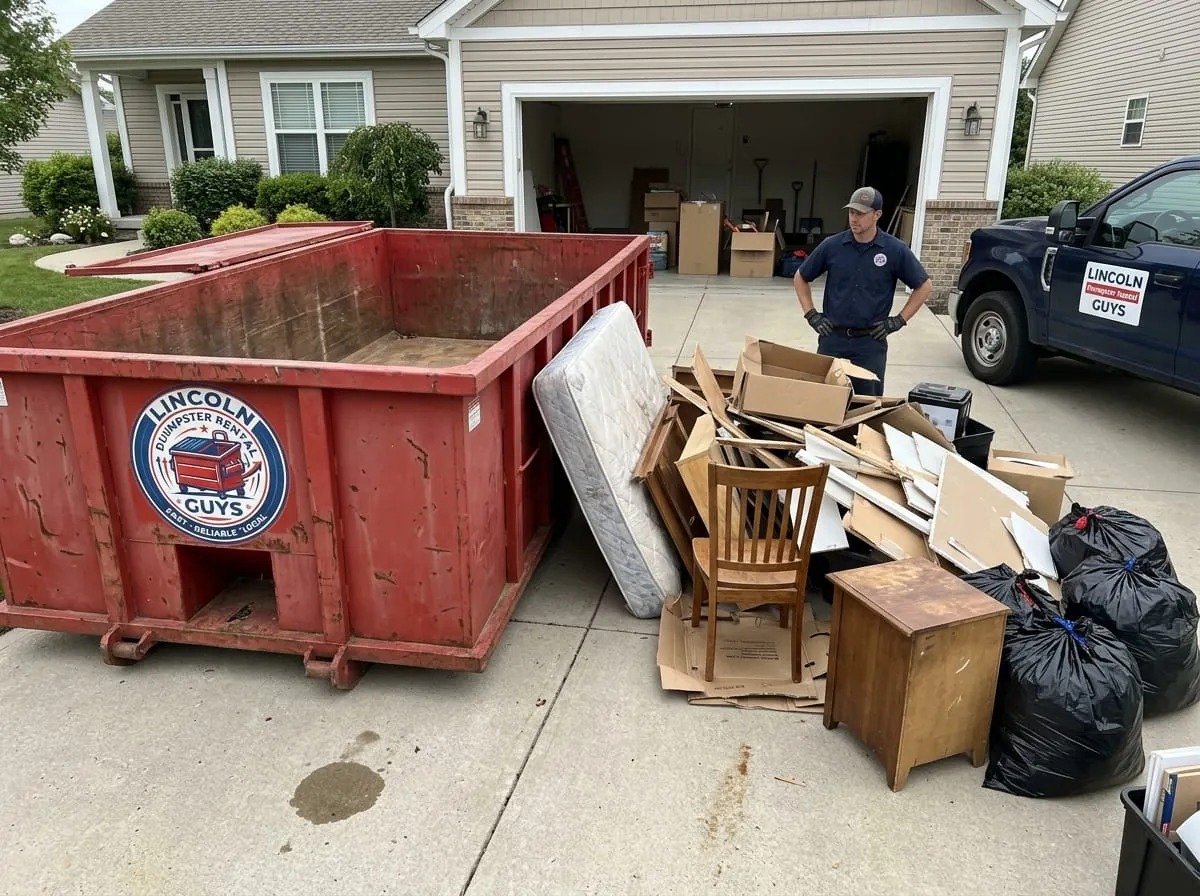
Every frame-and-brick build, basement finish, and subdivision tear-out in Lincoln generates a predictable stream of construction and demolition (C&D) debris. How you handle it decides whether your job site stays clean and inspection-ready or turns into a pile of overweight fees, rejected loads, and lost recycling credits. This guide walks Lancaster County builders and remodelers through the practical mechanics of separating, hauling, and disposing of C&D waste the right way the first time.
Know Your C&D Waste Streams
Construction and demolition debris is not one material. It is a bundle of very different waste streams, each with its own weight, recyclability, and disposal path. Sorting them in your head before the dumpster hits the driveway is the single biggest thing you can do to control cost. On a typical Lincoln residential project you are dealing with six major categories.
- Drywall (gypsum): Lightweight but bulky, and a headache in bulk. Whole or clean-cut scrap can sometimes be ground and land-applied or recycled; painted, mudded, or wet drywall almost always heads to the landfill.
- Lumber and dimensional wood: Framing offcuts, sheathing, and pallets. Clean, untreated wood is one of the easiest materials to divert. Treated, painted, or engineered lumber (OSB, LVL) is trickier and usually disposed of as mixed debris.
- Concrete: Footings, slabs, sidewalks, and driveway breakout. Heavy, inert, and highly recyclable when kept clean.
- Brick and masonry: Common on Lincoln's older frame-and-brick homes and chimney tear-downs. Like concrete, it is dense and recyclable as clean fill or crushed aggregate.
- Roofing: Asphalt shingles are heavy, tar-laden, and add up fast. Tear-offs routinely blow past weight limits on undersized bins.
- Siding: Vinyl, fiber cement, and wood siding. Bulky, light-to-moderate weight, and largely landfill-bound unless a specialty recycler is in play.
The moment you can name which of these streams a load is dominated by, you can pick the right container and avoid the two most expensive mistakes in the business: overweight tickets and rejected loads.
Separate Heavy Inert Debris From Everything Else
Here is the rule that saves Lincoln contractors the most money: never mix heavy inert debris with general C&D waste. Concrete, brick, block, asphalt, rock, and dirt are what haulers call "clean fill" or inert material. They are dense, they are recyclable, and they need their own dedicated container.
Why the hard line? Two reasons. First, weight. A 30-yard roll-off filled with mixed framing and drywall might weigh three to four tons. That same box filled with concrete would weigh 25 to 30 tons, which no roll-off truck can legally or safely haul on Nebraska roads. Second, recycling. Clean concrete and brick can be crushed and reused as aggregate, but only if they arrive uncontaminated by wood, plastic, and trash. One load of mixed debris ruins the recyclability of the whole box.
That is why demolition crews order a smaller, dedicated bin for the inert stream and a separate roll-off for everything else. A dedicated concrete and heavy debris container is built and priced around weight, not volume, so you fill it to a marked line rather than to the top. Trying to cram a slab breakout into a general-waste dumpster is how a $400 pull turns into a $1,500 overweight surprise.
| Debris Type | Weight Profile | Recommended Container |
|---|---|---|
| Concrete, brick, block, dirt | Very heavy (inert) | Dedicated 10-15 yd heavy-debris bin, filled to line |
| Asphalt shingle tear-off | Heavy | 20-yard roll-off |
| Framing, drywall, siding, mixed C&D | Light to moderate | 20 or 30-yard roll-off |
| Whole-house demolition | Mixed, high volume | 30 or 40-yard roll-off plus heavy-debris bin |
Understand Weight Limits and Why They Exist
Every roll-off comes with a tonnage allowance baked into the base rate, typically one to four tons depending on box size and hauler. Go over and you pay a per-ton overage on top. Those limits are not arbitrary. They reflect axle-weight laws, landfill scale fees, and the simple physics of what a truck can lift. Lincoln builders who track their loads know that shingles, concrete, plaster, wet drywall, and dirt are the usual culprits that push a box over its allowance.
The fix is planning, not luck. Estimate your heavy streams up front, keep dirt and concrete in their own dedicated bins, and never let a general C&D box become a dumping ground for spoils from a basement dig. When in doubt about whether a material belongs in the box at all, our guide on what can go in a dumpster lays out the prohibited items and weight traps in plain terms.
What Recycles in the Lincoln Area
Diversion is not just a green talking point in Lancaster County; it is a cost lever. Materials pulled out of the landfill stream often carry lower disposal costs and, on commercial work, feed directly into diversion reporting. The most commonly recycled C&D materials around Lincoln include:
- Clean concrete and masonry, crushed into recycled aggregate for road base and fill.
- Scrap metal, from rebar and conduit to ductwork and flashing, which almost always has salvage value and should be pulled separately.
- Clean, untreated wood, which can be chipped for mulch or biomass.
- Cardboard and packaging, which pile up fast on new-construction sites and are easy to keep out of the debris box.
- Asphalt shingles, which some regional processors accept for recycling into road-paving material when kept free of contaminants.
The key to capturing any of this value is source separation at the job site. A recycler will pay for a clean stream and reject a dirty one, so the decision about diversion is really a decision about how you set up your containers on day one.
Job-Site Container Logistics
Getting the container strategy right is half the battle. On a tight Lincoln residential lot or a busy subdivision build, placement, timing, and sizing all matter.
Placement
Put the roll-off where the debris is generated but where the delivery truck can still drop and retrieve it cleanly. Driveways are ideal; protect the surface with plywood under the rails if you are worried about scuffing. On new subdivisions with no driveway poured yet, stage the box on compacted ground clear of the framing crew and the concrete trucks. Keep at least 20 feet of overhead clearance free of power lines for the hoist.
Sizing
Match the box to the phase. A basement finish or single-room remodel usually lives inside a 20-yard dumpster. Whole-house remodels, additions, roofing tear-offs, and new-construction framing waste are better served by a 30-yard dumpster that cuts down on swap-outs and keeps the crew moving. When you are unsure, sizing up one step is almost always cheaper than paying for a second pull on an undersized box.
Timing and swaps
Order the box to arrive the day before demo starts, not the morning of, so a delivery delay never idles the crew. On multi-phase jobs, schedule swap-outs at natural breaks, after tear-out, after framing, after finish, so you are never paying to haul a half-empty box. Our construction dumpster rental service is built around this kind of phased scheduling for Lincoln builders.
Diversion and LEED Basics
If you are working on a commercial project, a public building, or a client chasing a green certification, waste diversion moves from optional to documented. LEED and similar programs award credit for the percentage of C&D waste diverted from the landfill by weight, and they require paper to prove it. That means weight tickets from every load, sorted by material, and a running tally of what was recycled versus landfilled.
Two paths get you there. Source separation, using dedicated bins for concrete, metal, wood, and cardboard, gives you the cleanest diversion numbers and the highest-value recyclables. Alternatively, a mixed C&D load sent to a processing facility that sorts on the back end can still earn credit, though usually at a lower diversion rate. Either way, keep every scale ticket. On a LEED job, the tickets are the deliverable as much as the finished building.
Staying Compliant With Nebraska DEE and the Lincoln Landfill
Disposal in Lincoln runs through the Lincoln/Lancaster County solid waste system, and the rules are enforced by the Nebraska Department of Environment and Energy (DEE). C&D debris from the metro area is handled at the county's facilities, including the North 48th Street transfer and the Bluff Road landfill, where loads are weighed at the scale and charged by tonnage.
A few compliance points every Lincoln contractor should have committed to memory:
- Cover and secure every load hauled to the landfill. Nebraska law requires debris to be tarped or contained so nothing blows onto the roadway. A licensed roll-off hauler handles this for you, which is one reason to let the pros pull the box rather than borrowing a trailer.
- Keep banned materials out of the C&D stream. DEE rules and landfill policy prohibit items like liquids, tires, appliances with refrigerant, hazardous waste, asbestos-containing material, and electronics from going in with general debris. These have separate handling requirements, and a load caught with them can be rejected at the scale.
- Treat regulated materials separately. Asbestos and lead-painted components from older Lincoln homes trigger specific abatement and disposal rules under state and federal law. Never let them end up in a standard demolition box.
- Segregate inert fill. Clean concrete, brick, and dirt are often directed to specific fill or recycling areas rather than the active landfill face, which is another reason keeping them separate pays off.
The simplest way to stay on the right side of DEE and county rules is to work with a hauler who runs the scale every day and knows exactly what the current facility will and will not accept. That is where a licensed local roll-off dumpster rental partner earns its keep.
Put It Together on Your Next Job
Disposing of construction debris well comes down to a handful of disciplined habits: name your waste streams before you order, keep heavy inert debris in its own dedicated bin, size the roll-off to the phase, capture the recyclables that carry value, document your diversion when the job demands it, and haul everything to the Lincoln/Lancaster County landfill in covered, compliant loads. Do that on every project and debris disposal stops being a cost surprise and becomes just another line you control.
Lincoln Dumpster Rental Guys sets up C&D and heavy-debris containers for builders and remodelers across Lincoln and Lancaster County, and we know exactly what the local landfill will take. Call (531) 229-1565 or reach out through our contact page to size the right box for your next tear-out, build, or basement job.

Founder, Lincoln Dumpster Rental Guys — sharing straight advice from more than 15 years of local hauling experience.
Frequently Asked Questions
Can I put concrete and dirt in the same dumpster as my other construction debris?
No. Concrete, brick, and dirt are heavy inert materials that need their own dedicated container. Mixing them into a general C&D box will blow past the roll-off's weight limit, trigger costly overage fees, and ruin the recyclability of the clean fill. Order a separate heavy-debris bin for the inert stream and a standard roll-off for framing, drywall, and mixed waste.
What size dumpster do I need for a construction project in Lincoln?
It depends on the phase. A single-room remodel or basement finish usually fits in a 20-yard dumpster, while whole-house remodels, additions, roofing tear-offs, and new-construction framing waste are better served by a 30-yard roll-off. Heavy concrete and masonry should always go in a smaller dedicated heavy-debris bin priced by weight rather than volume. When in doubt, sizing up is cheaper than paying for a second pull.
Which construction materials can I recycle in the Lincoln area?
Clean concrete and masonry can be crushed into recycled aggregate, scrap metal and rebar have salvage value, clean untreated wood can be chipped for mulch, and cardboard and asphalt shingles are recyclable when kept free of contaminants. The key is source separation at the job site: recyclers pay for a clean stream and reject a dirty one, so set up your containers to keep those materials separate from day one.
Where does construction debris go when it's hauled from a Lincoln job site?
C&D debris from the Lincoln metro area is handled through the Lincoln/Lancaster County solid waste system, including the North 48th Street transfer site and the Bluff Road landfill, where loads are weighed at the scale and charged by tonnage. Clean inert fill like concrete and brick is often directed to separate fill or recycling areas rather than the active landfill face.
What construction materials are banned from a standard C&D dumpster?
Nebraska DEE rules and county landfill policy prohibit liquids, tires, appliances containing refrigerant, hazardous waste, asbestos-containing material, lead-painted debris, and electronics from going in with general construction debris. These items have separate handling and disposal requirements, and a load caught with them can be rejected at the scale. Keep them out of the box and handle regulated materials through the proper channels.