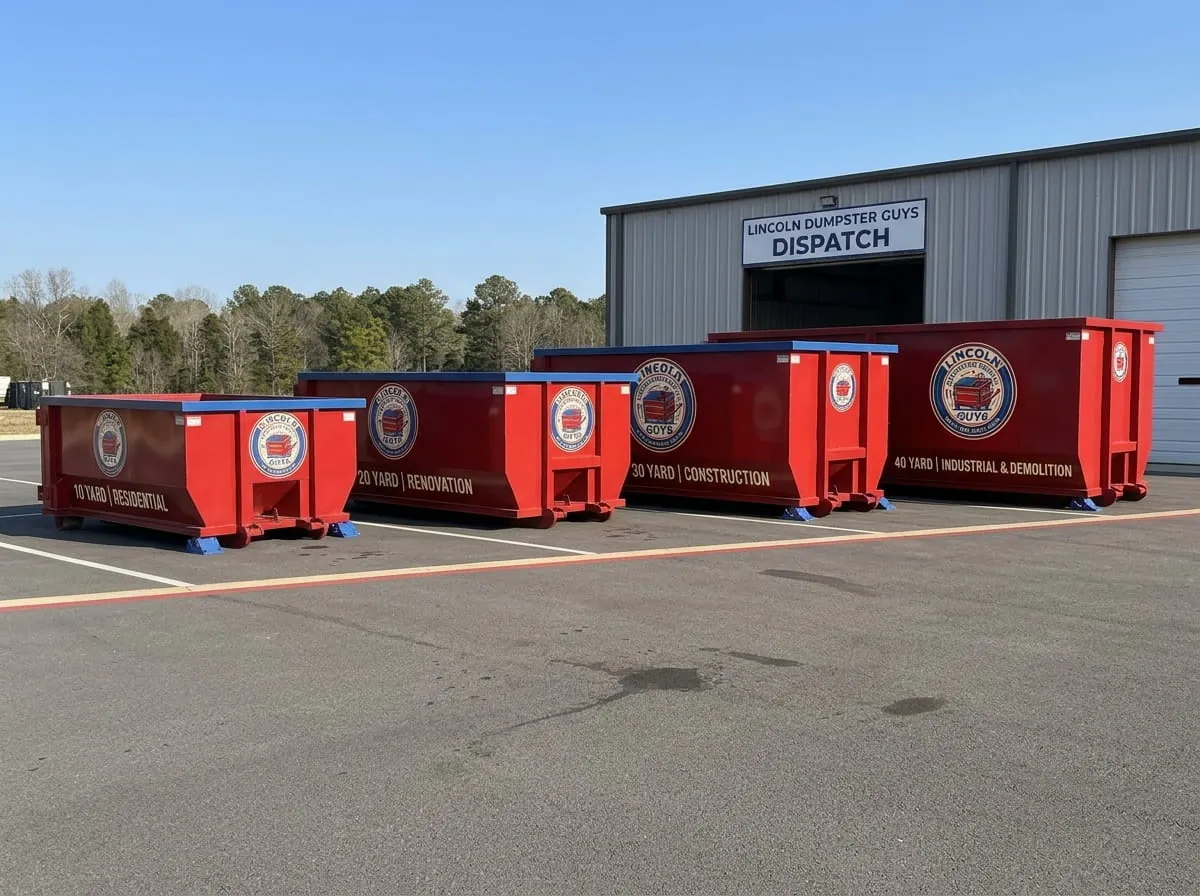
Choosing a dumpster size is the question we field most at the phone every single day, and it is the one that quietly decides whether your project runs clean or turns into a headache. Order too small and you are paying for a second haul or watching debris pile up on the driveway. Order too big and you are renting air, plus you have a bigger footprint eating up space in the yard through a Lincoln winter. After years of dropping roll-offs from the Near South and University Place to the newer subdivisions off Yankee Hill and out toward north Lincoln, we have learned that the right answer is almost always simpler than people expect. This guide walks you through the four common roll-off sizes, their real dimensions, what they actually hold, the weight limits that catch people off guard, and how to match a bin to the job you are doing right here in Lancaster County.
The four sizes we run in Lincoln
Nearly every residential and light-commercial job in the city fits one of four roll-off containers: the 10-yard, the 15-yard, the 20-yard, and the 30-yard. The number refers to cubic yards of volume, not weight, which is the single biggest point of confusion. A 10-yard box holds ten cubic yards of loose material. That volume tells you how much stuff fits; the weight limit tells you how heavy that stuff is allowed to be before overage fees kick in. Keep those two ideas separate in your head and you are already ahead of most first-time renters.
10-yard roll-off
Footprint is roughly 12 to 14 feet long, 8 feet wide, and about 3.5 feet tall. It holds around ten cubic yards, which is the equivalent of about three to four pickup truck loads. This is our heavy-debris and small-project workhorse. It fits on a single driveway with room to spare, which matters on the tighter lots around UNL and the older brick homes in the Near South and Everett neighborhoods where you do not have a sprawling suburban drive to work with. Think single bathroom remodel, a small deck removal, a garage purge, or a modest concrete or dirt job. Because it is low to the ground it is easy to load by hand and easy to tuck out of the way.
15-yard roll-off
Around 14 to 16 feet long, 8 feet wide, and about 4 feet tall. This is the in-between size, and honestly the one that saves the most people money. Fifteen yards holds roughly five to six pickup loads. It is the sweet spot for a mid-size basement cleanout, a larger single-room remodel, or a re-roof on a smaller ranch. If you find yourself torn between a 10 and a 20, the 15 is usually the honest answer. It gives you real breathing room over the 10 without paying for capacity you will never fill.
20-yard roll-off
About 20 to 22 feet long, 8 feet wide, and roughly 4.5 feet tall. Holds around eight pickup loads. The 20 is our most popular all-around residential size, and for good reason. It swallows a full kitchen remodel, a two-room flooring tear-out, a whole-basement cleanout, or a standard-size roof tear-off. The walls are still low enough to load without a ramp for most people, but the volume is generous enough that you are not rationing space. If you are doing a serious decluttering of a full home before a move or an estate cleanout, this is where most families land.
30-yard roll-off
Roughly 22 feet long, 8 feet wide, and about 6 feet tall. Holds around twelve pickup loads. The 30 is a construction and major-renovation container. New construction on the south and north edges of town, whole-home gut jobs, large additions, commercial cleanouts, and big landscaping projects all call for the 30. The taller walls mean you will want to load bulky, lightweight material here, and you may need to toss items up and over. It is the largest box we run for standard roll-off service.
Weight limits and overage fees, explained plainly
Every dumpster comes with an included weight allowance, and going over it is the number one way people get a bill bigger than they expected. Ton limits vary by container and by the rate you book, but as a rough Lincoln benchmark: a 10-yard typically includes 1 to 2 tons, a 15-yard 2 to 3 tons, a 20-yard 2 to 4 tons, and a 30-yard 3 to 5 tons. Anything over the included tonnage is billed per ton at the landfill scale rate. This is not a gotcha; it is simply how disposal is priced, because the transfer station charges us by weight. When you call, tell us honestly what is going in the box and we will match the allowance so there are no surprises. You can always see how the numbers shake out on our Lincoln dumpster cost breakdown.
Heavy debris: why small bins are the right call
Here is the counterintuitive rule that trips up nearly everyone. When your load is heavy, you want a smaller box, not a bigger one. Concrete, brick, dirt, sod, asphalt, roofing shingles, and plaster are dense. A 20-yard container filled to the top with broken concrete would weigh far more than any truck is legally allowed to haul on Nebraska roads, and you would blow past your tonnage allowance many times over. For that reason we cap heavy, clean fill in a 10-yard box, and often we ask that heavy material stay in a dedicated bin so it can be recycled cleanly rather than mixed with general trash.
This comes up constantly in Lincoln because of our housing stock and our weather. Freeze-thaw cycles chew up driveways, patios, and sidewalks every winter, so concrete replacement is a year-round job here. Older brick homes near campus shed heavy masonry when chimneys or foundations get worked on. And after the hail and wind storms that roll across southeast Nebraska, re-roofs generate mountains of shingles that are far heavier than they look. A single square of asphalt shingle tear-off can run 250 pounds or more, so a full roof puts serious weight into the box fast. For any of these, a 10 or 15 is the safe, cost-effective pick. If you are unsure whether your material qualifies as heavy debris, our guide on what can and cannot go in a dumpster spells it out.
Matching the size to the job
Rules of thumb are helpful, but the fastest way to get it right is to picture your specific project. Here is how the common Lincoln jobs shake out.
| Project | Recommended size | Why |
|---|---|---|
| Single bathroom remodel | 10-yard | Tile, vanity, tub, drywall from one room fits easily; low walls load fast |
| Basement cleanout | 15 or 20-yard | Years of stored items add up in volume; light debris fills space quickly |
| Kitchen remodel | 20-yard | Cabinets, countertops, flooring, and drywall from a full kitchen |
| Roof tear-off (average home) | 10 or 15-yard | Shingles are heavy; smaller box keeps you under tonnage |
| Whole-home renovation | 30-yard | Multiple rooms of bulky, mixed debris at once |
| New construction / addition | 30-yard | Framing offcuts, packaging, and jobsite waste in high volume |
| Concrete or dirt removal | 10-yard | Dense material; weight, not volume, is the limit |
| Estate or full-home cleanout | 20 or 30-yard | Furniture and household goods take up a lot of room |
The Lincoln basement factor
One thing that sets our market apart from a lot of the country is how common full basements are on Lincoln homes. From the century-old houses in the Near South to the split-levels and ranches across the city, basements are where decades of belongings quietly accumulate. When those get cleaned out, whether for a finishing project, a flood recovery after a heavy spring storm, or an estate settlement, the volume surprises people every time. Boxes and old furniture are bulky but light, so a 20-yard usually fits the bill and gives you room to work without a mid-job refill. If the basement is also being demoed down to studs, step up to the 30.
Winter and weather planning
Do not overlook the calendar. Snow and ice mean your container may sit on the driveway longer than planned, and a smaller footprint is easier to work around when you are also clearing snow. If you are doing a re-roof after a hailstorm, the tear-off often happens in a tight weather window, so we recommend booking the bin ahead of the crew so it is staged and ready the morning they start. We drop and swap efficiently, but a little planning around Nebraska weather goes a long way.
When in doubt, size up one step, unless it is heavy
For light and bulky material, the cheapest mistake is a second haul, so if you are genuinely between two sizes and the debris is lightweight, size up. The incremental cost of the next box is almost always less than an extra pickup and delivery. But if the load is heavy, the rule flips: stay small and manage weight. That single distinction resolves most of the guesswork.
Still not certain? That is exactly what we are here for. Tell us the project and the neighborhood and we will recommend the right box the first time. Browse our full lineup on the roll-off rental page or reach out through our contact page and we will get you set.
Get the right size the first time
Lincoln Dumpster Rental Guys has been sizing bins for Lancaster County homeowners and contractors long enough to know the local jobs cold. Whether it is a Near South remodel, a south Lincoln new build, or a storm-season re-roof, we will match you to the right container and be straight with you about weight and cost. Call us at (531) 229-1565 and we will get the right roll-off on your driveway.

Founder, Lincoln Dumpster Rental Guys — sharing straight advice from more than 15 years of local hauling experience.
Frequently Asked Questions
What is the most popular dumpster size for a home project in Lincoln?
The 20-yard roll-off is our most requested residential size. It comfortably handles a full kitchen remodel, a whole-basement cleanout, or a full-home decluttering, while its walls stay low enough to load without a ramp. If your debris is heavy, such as concrete or roofing shingles, we steer you toward a 10-yard instead.
Why do you put heavy debris like concrete in a small 10-yard dumpster?
Because dense material is limited by weight, not volume. Concrete, dirt, brick, and shingles are so heavy that a full 20 or 30-yard box would exceed legal road weight limits and blow past your tonnage allowance. A 10-yard keeps the load safe, legal, and affordable. Freeze-thaw driveway jobs and re-roofs come up constantly in Lincoln, so this is a routine recommendation for us.
What happens if I go over the weight limit?
Each dumpster includes a set tonnage allowance, and anything over it is billed per ton at the landfill scale rate. It is not a penalty, just a pass-through of what the transfer station charges by weight. When you book, tell us honestly what is going in the box and we will match the allowance so there are no surprises on your bill.
Will a roll-off dumpster fit on my driveway?
In almost every case, yes. A 10-yard needs about 12 to 14 feet of length and a 30-yard around 22 feet, and all our boxes are 8 feet wide. On the tighter lots near UNL and in the Near South we usually recommend a 10 or 15-yard, while newer south and north Lincoln subdivisions have plenty of room for a 20 or 30. We place a board under the container to protect your surface.
What size do I need for a basement cleanout in Lincoln?
Most Lincoln basement cleanouts fit a 15 or 20-yard roll-off. Basements here hold decades of bulky but lightweight items, so volume fills faster than people expect. If the basement is being demoed to the studs on top of clearing it out, step up to a 30-yard to avoid a second haul.